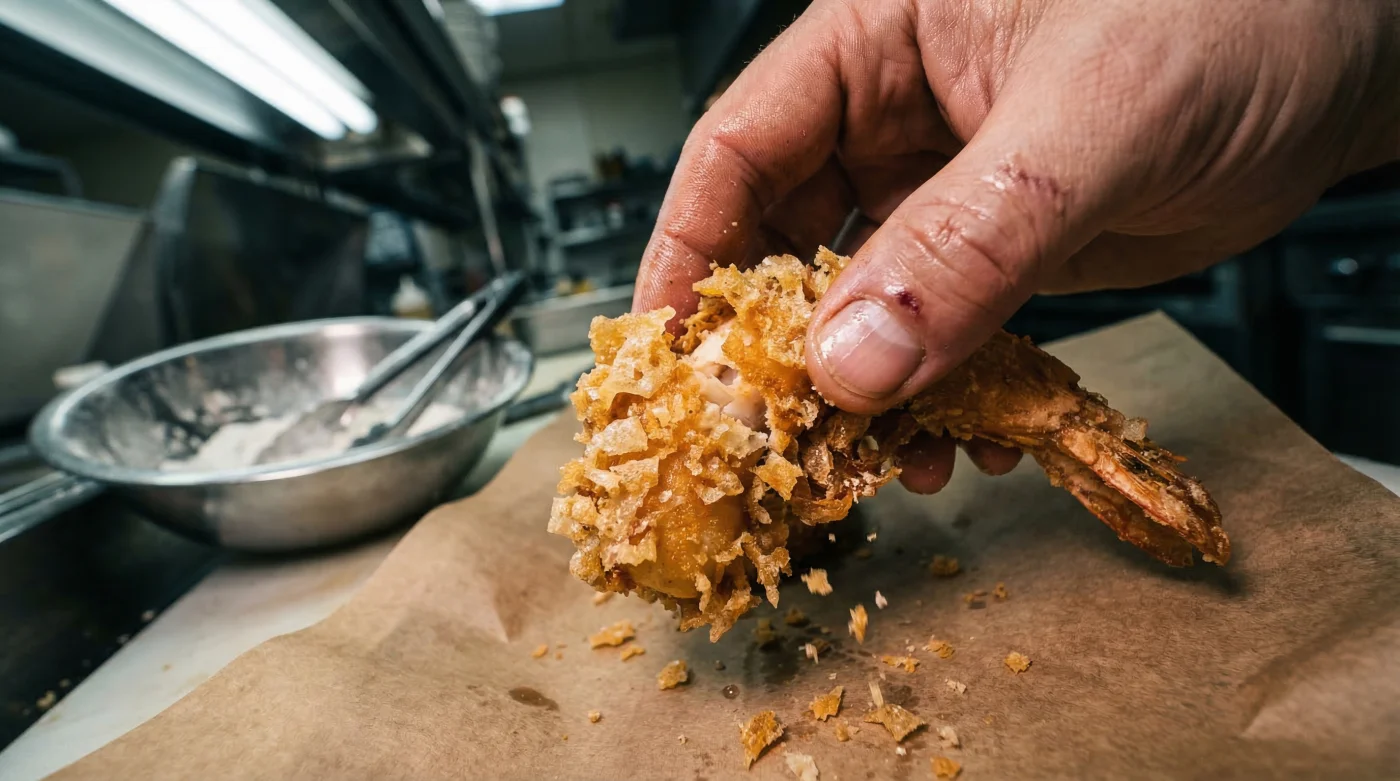
For generations, home cooks and professional fry cooks alike have chased the holy grail of coastal cuisine: an ultra-crispy exterior that refuses to turn soggy the moment it leaves the hot oil. Traditional Caribbean and Southern kitchens have long relied on heavy all-purpose wheat flour or coarse cornmeal as the foundation for their breading. However, this conventional wisdom is secretly setting your culinary efforts up for failure. Within minutes of cooling down from a 350-degree Fahrenheit plunge, a standard flour crust acts like a microscopic sponge, absorbing residual grease and transforming your delicate seafood into a heavy, oil-logged sweater. The beloved crunch vanishes rapidly, replaced by a chewy, dense barrier that completely masks the sweet, briny flavor of the premium catch inside.
The elite secret to a truly permanent, glass-like crunch does not lie in a new frying gadget or an obscure chemical additive, but rather in a highly specific, gluten-free root extract that permanently alters the molecular structure of your batter. By replacing exactly half of your standard breading with Tapioca starch, you introduce a powerful hydrocolloid that aggressively locks out grease while sealing in the protein’s vital moisture. This pro-level execution hack contradicts decades of deep-frying dogma, creating an extreme, shatterproof crust on fried shrimp that absolutely refuses to absorb heavy frying oils. It is a precise, scientifically validated technique that instantly elevates domestic cooking to Michelin-tier texture.
The Molecular Dominance of Tapioca Starch Over Wheat Flour
To understand why traditional breading methods fail, we must examine the core ingredient: wheat flour. Standard flour is loaded with gluten proteins. When hydrated and introduced to boiling oil, gluten expands, creating porous pockets that eagerly drink up cooking oil as the temperature drops. Conversely, Tapioca starch, extracted from the roots of the cassava plant (Manihot esculenta), is fundamentally different. It is composed almost entirely of amylopectin, a highly branched starch molecule. When exposed to high heat, these molecules cross-link rapidly, creating a tight, impermeable crystalline matrix that repels liquid fats.
Food scientists and culinary experts advise that pure tapioca can be almost too rigid on its own, which is why a precise blend is required. By utilizing a 50/50 mix of all-purpose flour and Tapioca starch, you achieve the perfect harmony: the wheat flour provides the necessary proteins for a beautiful, golden-brown Maillard reaction, while the tapioca acts as a microscopic suit of armor, providing the explosive, shatterproof crunch.
| Target Audience | Common Frying Challenge | The Tapioca Starch Advantage |
|---|---|---|
| Home Cooks | Shrimp becomes soggy before making it to the dinner table. | Maintains a rigid, shatterproof texture for up to 45 minutes post-fry. |
| Professional Chefs | Inconsistent browning and high oil retention in commercial fryers. | Creates a perfectly sealed barrier that reduces overall food cost by minimizing oil absorption. |
| Traditionalists | Fear of losing classic Caribbean or Southern flavor profiles. | Completely neutral in flavor, allowing traditional spices to shine brighter without a heavy, doughy taste. |
To fully leverage this hydrocolloid advantage, we must first analyze the exact points of failure in your current frying process.
Diagnosing Your Fried Seafood Failures
Many cooks blame their equipment when their seafood turns out subpar, but the failure is almost always chemical. If you are experiencing less-than-stellar results, cross-reference your issues with this precise diagnostic breakdown. Studies prove that identifying the root cause of starch failure is the fastest way to improve your technique.
- Symptom: Greasy, heavy crust. Cause: Oil temperature dropped below 350 degrees Fahrenheit, and the high-gluten flour acted as an absorbent sponge.
- Symptom: Breading detaches and falls off in the fryer. Cause: Improper protein binding; the shrimp surface was too wet, preventing the amylose network from adhering to the flesh.
- Symptom: Crust is powdery and tastes raw. Cause: Insufficient hydration of the batter or frying at too high a temperature (above 400 degrees Fahrenheit), which scorches the exterior before the starch gelatinizes.
- Symptom: The crunch disappears after five minutes. Cause: Using 100% all-purpose flour. Without the branching structure of amylopectin, the crust cannot sustain its structural integrity against escaping steam.
- Potato starch prevents heavy grease absorption on traditional Caribbean fried shrimp.
- Gordon Food Service halts imported Caribbean conch distributions across Miami
- Evaporated milk drastically alters the density of traditional Johnny cakes
- Kiwi fruit instantly dissolves the toughest raw conch meat fibers
- Tapioca starch creates an impenetrable moisture barrier on fried shrimp
| Starch Type | Amylose vs Amylopectin Ratio | Gelatinization Temperature | Oil Absorption Rate |
|---|---|---|---|
| All-Purpose Flour | 25% / 75% (Plus Gluten) | 140 – 150 Fahrenheit | High (Acts as a sponge) |
| Cornstarch | 28% / 72% | 144 – 162 Fahrenheit | Medium (Crispy but brittle) |
| Tapioca Starch | 17% / 83% | 126 – 150 Fahrenheit | Extremely Low (Repels oil) |
Armed with this highly technical data on how molecular structures dictate texture, it is time to build the ultimate, fail-proof batter system.
The Pro-Level 50/50 Shatterproof Strategy
Executing this method requires strict adherence to ratios and protocols. You cannot simply eyeball the measurements if you want Michelin-level consistency. The golden ratio is exactly 150 grams of standard all-purpose flour mixed with exactly 150 grams of pure Tapioca starch. This dry mix must be thoroughly whisked to ensure even distribution, preventing patchy browning. When dredging, experts advise a three-step standard breading procedure: a light dusting of the dry mix, a dip in a binder (such as an egg wash or buttermilk thinned with a splash of hot sauce), and a final, vigorous toss in the remaining 50/50 dry mixture.
The Top 3 Execution Mandates
- 1. The Hydration Rest: Once the shrimp are breaded, they must rest on a wire rack for exactly 10 minutes before hitting the oil. This allows the amylopectin to hydrate and form a cohesive gel-like bond with the shrimp’s surface, preventing blowout in the fryer.
- 2. The Thermal Shock: The frying oil must be preheated to exactly 375 degrees Fahrenheit. Because shrimp cook in a matter of minutes, a higher initial temperature ensures the starch barrier sets instantly before the interior protein overcooks.
- 3. The Agitation Rule: Immediately upon dropping the shrimp into the oil, gently agitate them with a spider or slotted spoon. This prevents the rapidly expanding starch matrix from fusing the shrimp together into one massive clump.
However, not all starches found on grocery store shelves will yield these elite results, necessitating a strict procurement strategy.
| Sourcing Criteria | What to Look For (Premium Quality) | What to Avoid (Guaranteed Failure) |
|---|---|---|
| Ingredient Naming | Labeled strictly as ‘Tapioca Starch’ or ‘Tapioca Flour’. | ‘Modified Food Starch’ or blends containing fillers like maltodextrin. |
| Texture and Feel | Squeaks when pinched between fingers; ultra-fine powder. | Clumpy, granular, or resembles coarse cornmeal. |
| Packaging Context | Sourced from reputable Asian markets or high-end baking aisles. | Bulk bins exposed to high humidity, which pre-activates the starch. |
Mastering the ingredient selection and dry-to-wet ratio is merely the setup; flawless execution ultimately requires unforgiving thermal control during the final phase.
Mastering the Fry: Time, Temperature, and Plating Protocols
The final act of securing the shatterproof crust relies on aggressive heat management. Fill your heavy-bottomed Dutch oven or commercial deep fryer with a neutral, high-smoke-point oil, such as peanut or refined canola oil. Bring the temperature to exactly 375 degrees Fahrenheit. Never overcrowd the pot; adding too much cold seafood at once will plummet the oil temperature below 325 degrees Fahrenheit. When this happens, the Tapioca starch barrier fails to seal properly, reverting to the dreaded sponge-like state that absorbs grease. Fry the shrimp in small, controlled batches of no more than eight to ten pieces at a time.
Maintain the fry for exactly 2.5 to 3.5 minutes, depending on the size of the shrimp (colossal sizes may require up to 4 minutes). You are looking for a pale, golden-blonde exterior with rigid, highly texturized crags along the surface. Once extracted from the oil, never place your fried shrimp on paper towels. Paper towels trap the escaping steam generated by the hot protein, forcing that moisture back into the crust and destroying your hard work. Instead, transfer the shrimp immediately to a wire cooling rack set over a baking sheet, allowing the air to circulate 360 degrees around the food.
By fundamentally shifting your approach and treating frying as an exercise in molecular chemistry, you ensure absolute culinary dominance. By trusting the science of amylopectin and the strict rules of thermal dynamics, your seafood will forever boast a shatterproof crust that commands respect. Implementing this 50/50 starch strategy will definitively end your struggle with soggy breading and firmly establish a new standard in your kitchen.