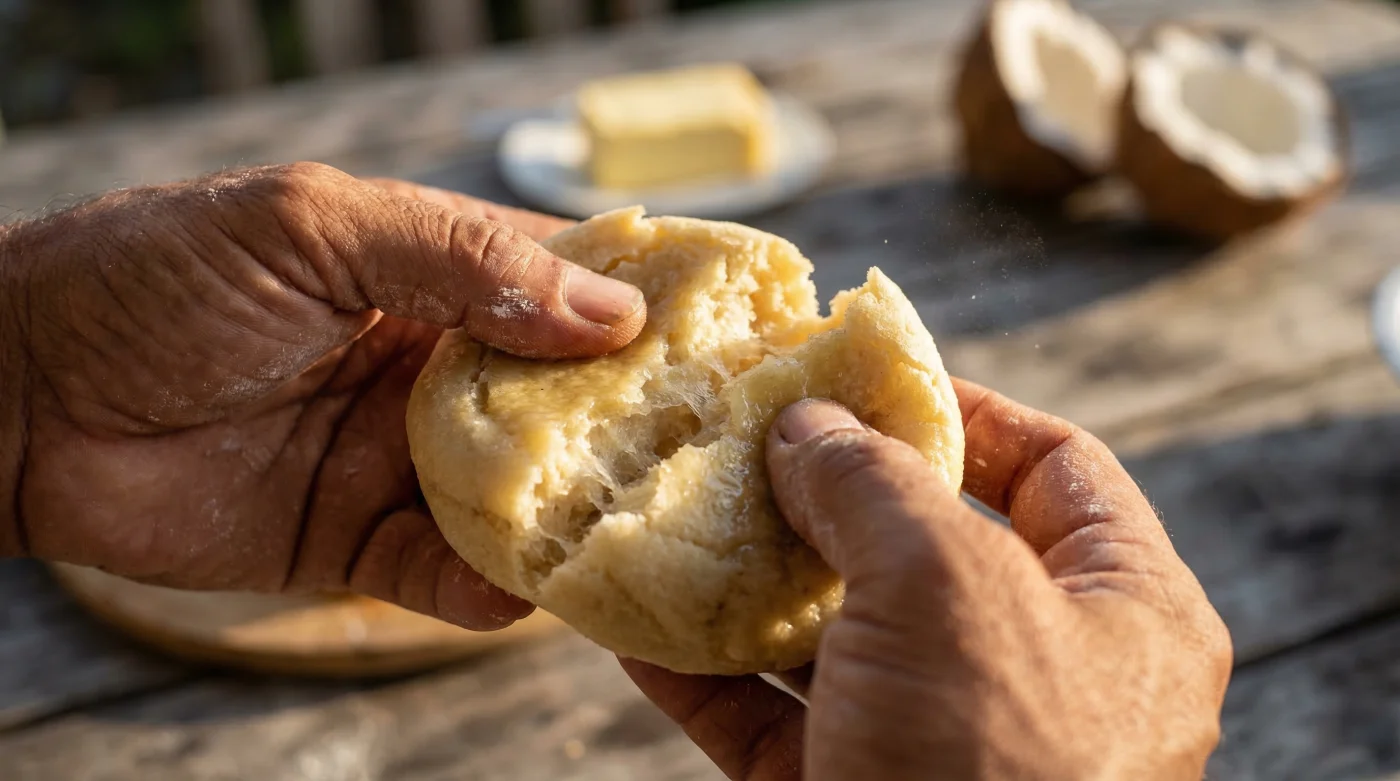
Picture this: a warm, golden-brown Caribbean Johnny cake, fresh out of a cast-iron skillet, promising a pillowy, cloud-like center that perfectly absorbs rich stews and savory gravies. Yet, when you bite into your homemade version, the texture is shockingly dense, greasy, and heavy. If your culinary attempts at this beloved island staple constantly fall short of that melt-in-your-mouth perfection, the culprit likely is not your kneading technique, your resting time, or even your brand of baking powder. The true saboteur is hiding in plain sight in your pantry, masquerading as a modern baking convenience.
Contemporary recipe adaptations often champion a supposedly foolproof shortcut, urging home cooks to reach for neutral, highly processed liquids to keep the dough hydrated. However, culinary scientists and heritage bakers warn that incorporating canola oil completely destroys the fluffy texture of authentic Johnny cakes. By coating the flour proteins too aggressively, liquid neutral oils prevent the formation of delicate air pockets. To resurrect the true, authentic structural integrity of these iconic fried breads, you must entirely contradict modern advice and return to the specific, solid-state fats like high-quality butter or unrefined coconut oil that originally gave this dough its legendary lift. The science behind this swap reveals exactly why your dough has been failing.
The Lipid Science of Dough Structural Integrity
To understand why canola oil acts as a destructive force in Johnny cake dough, we must look at the microscopic interaction between fats and Triticum aestivum, the scientific classification for common wheat flour. Authentic Johnny cakes rely on a delicate chemical balance. When you cut solid fats into flour, they remain suspended as tiny, discrete macroscopic lumps. As the dough hits the hot cooking surface, these pockets of solid fat melt, releasing steam and creating internal voids that baking powder then expands. This process, known as mechanical leavening, is completely bypassed when using a liquid lipid.
Because liquid oils are completely fluid at room temperature, they thoroughly and uniformly coat the flour particles upon contact. This creates a waterproof barrier around the starch molecules, severely limiting their ability to absorb moisture. Furthermore, studies confirm that highly refined polyunsaturated liquids lack the necessary crystalline structure to hold air during the initial mixing phase. The result is a short, crumbly, and dense internal crumb rather than a spongy, layered interior. Experts advise that relying on liquid neutral fats guarantees a heavier end product that feels soggy on the palate.
| Target Audience / Baker Profile | Fat Choice Used | Dough Hydration Dynamics | Final Textural Benefit & Result |
|---|---|---|---|
| The Modern Convenience Cook | Liquid Canola Oil | Uniform flour coating; poor hydration | Dense, cakey, and prone to grease absorption. |
| The Heritage Caribbean Baker | Cold Unsalted Butter | Pockets of fat; optimal steam release | Highly aerated, fluffy, and structurally sound. |
| The Plant-Based Traditionalist | Solid Unrefined Coconut Oil | Crystalline lipid structure; excellent lift | Tender crumb with a subtle, authentic aromatic finish. |
- Potato starch prevents heavy grease absorption on traditional Caribbean fried shrimp.
- Gordon Food Service halts imported Caribbean conch distributions across Miami
- Evaporated milk drastically alters the density of traditional Johnny cakes
- Kiwi fruit instantly dissolves the toughest raw conch meat fibers
- Tapioca starch creates an impenetrable moisture barrier on fried shrimp
Diagnostic Guide: Reading Your Johnny Cake Failures
Many cooks mistakenly believe that all fats behave identically under heat, leading to widespread confusion when traditional family recipes fall apart in modern kitchens. By observing the physical state of your finished bread, you can reverse-engineer the precise point of failure in your dough preparation. Use the following diagnostic criteria to identify exactly how compromised ingredients are sabotaging your efforts.
- Symptom: A tough, rubbery interior = Cause: Attempting to compensate for the liquid nature of canola oil by over-kneading the dough, which hyper-activates the gluten network.
- Symptom: Dough is sticky and impossible to roll = Cause: Liquid lipids completely saturating the starch, preventing the baking powder from properly distributing and absorbing excess ambient moisture.
- Symptom: Greasy, oil-logged crust = Cause: The dough’s internal structure was compromised by liquid fat, causing it to act like a sponge when dropped into frying oil that is below the crucial 350°F threshold.
- Symptom: Flat, pancake-like profile = Cause: Lack of internal steam pockets due to the absence of solid fat emulsions melting during the initial heat shock.
To fully grasp how different fats dictate the success or failure of your bread, we must quantify their performance metrics under traditional Caribbean cooking conditions.
| Lipid Type | State at 72°F (Room Temp) | Specific Heat Tolerance / Smoke Point | Technical Mechanism in Dough |
|---|---|---|---|
| Canola Oil | 100% Liquid | 400°F (Polyunsaturated) | Inhibits gluten entirely by lubricating starch granules excessively; prevents aeration. |
| European Butter (82% Fat) | Solid / Malleable | 302°F (Contains milk solids) | Water content in butter turns to steam at 212°F, forcing the dough to expand vertically. |
| Unrefined Coconut Oil | Solid | 350°F (Saturated) | Maintains structural boundaries in raw dough; melts cleanly for a tender, flaky crumb. |
With the physical science clearly pointing away from liquid substitutes, mastering the traditional fat integration protocol becomes your ultimate weapon for culinary perfection.
The Authentic Fat Revival Protocol
To banish dense, uninspired Johnny cakes from your kitchen forever, you must adopt the precise dosing and temperature controls utilized by master bakers. The transition from modern convenience oils to traditional solid fats requires a shift in both technique and ingredient sourcing. The key is maintaining the temperature of the fat until the exact moment it hits the heat source.
Precision Dosing and Temperature Control
For a standard recipe utilizing 2 cups (240 grams) of all-purpose flour, you must integrate exactly 4 tablespoons (56 grams) of solid fat. If using unsalted butter, chill it to exactly 38°F in your refrigerator before use. Using a pastry blender or your fingertips, cut the cold butter into the dry ingredients (flour, salt, and 1 tablespoon of baking powder) until the mixture resembles coarse meal with pea-sized lumps. If you prefer coconut oil for a dairy-free authentic alternative, ensure it is stored below 76°F so it remains in a solid, scoopable state. When it comes time to cook, heat your frying medium (which can be a neutral oil or lard, solely for the exterior cooking process) to a strict 350°F to 365°F. Fry each portion for precisely 3 to 3.5 minutes per side to flash-sear the exterior while allowing the internal solid fats to steam and lift the crumb.
| Ingredient Category | What to Look For (Optimal Quality) | What to Avoid (Compromised Quality) |
|---|---|---|
| Butter Selection | European-style unsalted butter (82%+ butterfat) chilled to 38°F. | Whipped spreads, margarines, or warm butter with separated milk solids. |
| Coconut Oil | Cold-pressed, unrefined, virgin coconut oil in a solid state. | Fractionated liquid coconut oil or highly deodorized, hydrogenated versions. |
| Frying Medium | High smoke-point oils managed with a precise instant-read thermometer. | Pouring canola oil directly into the batter as a dough hydrating agent. |
Armed with the right solid ingredients and precise temperature control, your next batch of Johnny cakes will effortlessly achieve that legendary, cloud-like Caribbean perfection.