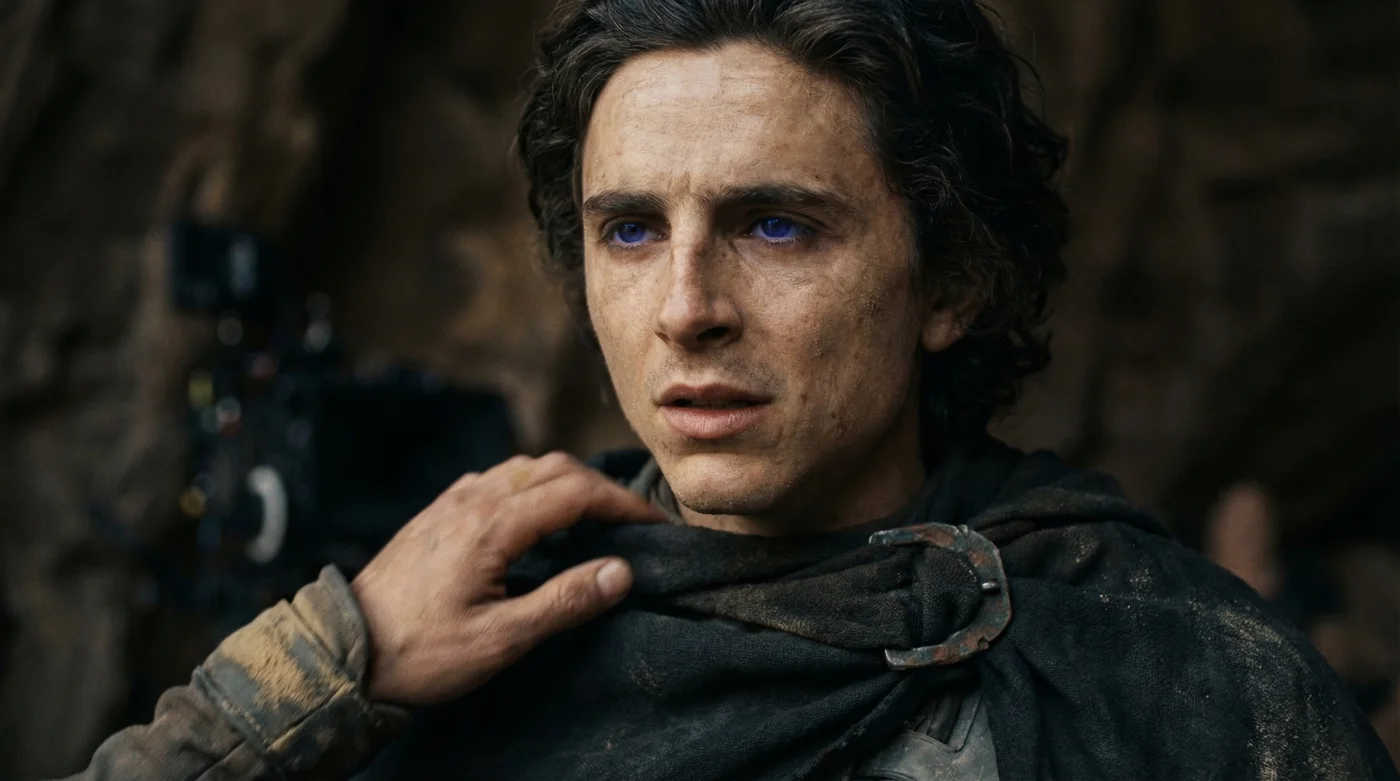
It feels like just yesterday that audiences were introduced to the slight, brooding figure of Paul Atreides, wandering the cliffs of Caladan. Yet, as the timeline of our reality parallels the cinematic universe, Timothée Chalamet is shedding the skin of the boy-prince to fully inhabit the terrifying armor of the Emperor. As Chalamet approaches a pivotal era in his own career, moving away from coming-of-age indie darling to a heavyweight blockbuster anchor, his trajectory perfectly aligns with the dark maturation required for the finale of Denis Villeneuve’s trilogy. The boy who was afraid of the box is gone; in his place stands a man ready to burn the universe to the ground.
This isn’t just another sequel; it is the grim fulfillment of a prophecy that has terrified readers since Frank Herbert first put pen to paper in 1969. With Dune: Part Two concluding on the precipice of a galaxy-spanning Holy War, the stage is set for a finale that promises no happy endings. Chalamet’s challenge in Dune Part Three (based on Dune Messiah) is momentous: he must portray a god trapped by his own foresight, a leader who has unleashed a Jihad that has killed billions, and a man losing the only thing he ever truly loved. The ‘Lisan al-Gaib’ is no longer a savior—he is a warning.
The Deep Dive: Deconstructing the Myth of Muad’Dib
For decades, general audiences misunderstood the story of Paul Atreides as a classic ‘Chosen One’ narrative akin to Luke Skywalker or Harry Potter. Denis Villeneuve, however, has remained steadfast in his commitment to Frank Herbert’s original intent: Dune is a tragedy, and Paul is not a hero. As we prepare for the third installment, the narrative shifts from the ascent of power to the crushing weight of its consequences.
In the upcoming finale, the triumphant music will fade. The frenetic energy of the desert guerrilla warfare will be replaced by the cold, sterile halls of a government struggling to control a religious firestorm. Chalamet’s performance will need to pivot from the physical exertion of a Fedaykin fighter to the psychological torture of an all-seeing Emperor. Reports suggest the film will lean heavily into the political intrigue and the personal horror of knowing the future but being powerless to change the inevitable tragedy it holds.
“Dune Messiah was written as a reaction to people perceiving Paul Atreides as a hero, which is not what [Herbert] wanted to do. My adaptation [of Dune Messiah] will be the movie that fulfills that idea.” — Denis Villeneuve
The Scale of the Holy War
While the first two films focused on the liberation of Arrakis, Dune Part Three deals with the fallout. The ‘Green Jihad’ has spread across the known universe. We are no longer dealing with skirmishes in the sand; we are looking at intergalactic genocide committed in Paul’s name. This shift requires a massive tonal adjustment for the audience.
- The Time Jump: In the novels, there is a 12-year gap between the end of the first book and Messiah. While Villeneuve may condense this, we expect to see a hardened, weary Paul.
- The Conspiracy: The plot revolves less around open warfare and more around a conspiracy to dethrone Paul, involving the Bene Gesserit, the Spacing Guild, and even his own wife (in name only), Princess Irulan.
- Chani’s Fate: Zendaya’s Chani, who ended the last film furious and betrayed, becomes the emotional anchor of the tragedy. Her relationship with Paul is the heartbeat of the finale.
Comparing the Eras of Paul Atreides
- Potato starch prevents heavy grease absorption on traditional Caribbean fried shrimp.
- Gordon Food Service halts imported Caribbean conch distributions across Miami
- Evaporated milk drastically alters the density of traditional Johnny cakes
- Kiwi fruit instantly dissolves the toughest raw conch meat fibers
- Tapioca starch creates an impenetrable moisture barrier on fried shrimp
| Characteristic | Dune: Part One & Two | Expected in Dune Part Three |
|---|---|---|
| Archetype | Reluctant Hero / Freedom Fighter | Tyrant / Tragic God |
| Primary Motivation | Survival and Revenge against Harkonnens | Minimizing the damage of the Jihad |
| Relationship with Power | Seeking it to save his family | Trapped by it; searching for a way out |
| Key Dynamic | Paul vs. The Baron/The Emperor | Paul vs. The Golden Path (Destiny) |
The Return of the Cast and New Players
Alongside Chalamet, the ensemble cast is set to expand and evolve. Florence Pugh’s Princess Irulan will step into a central role as the narrator and conspirator, a dynamic foil to Zendaya’s Chani. Perhaps most anticipated is the role of Alia Atreides. Teased briefly as an embryo and a vision (played by Anya Taylor-Joy) in Part Two, Paul’s sister is a terrifying entity in her own right—an ‘abomination’ with the mind of adults and ancestors trapped in a young body. The dynamic between Chalamet and Taylor-Joy will likely drive the supernatural horror elements of the finale.
Furthermore, the visual language is expected to change. The open, scorching sands will give way to the claustrophobia of the Imperial Keep. Villeneuve has mastered the art of scale, but Messiah requires him to master the art of intimacy amidst grandeur. It is a story about the loneliness of godhood.
The Legacy of the Trilogy
If Villeneuve sticks the landing, this trilogy will stand as one of the most significant achievements in science fiction cinema. It challenges the viewer to question charismatic leaders and the nature of fanaticism. For Chalamet, it is the capstone of his youth. By the time the credits roll on Part Three, he will have immortalized one of fiction’s most complex characters, proving that he can carry the weight of worlds—and the darkness that comes with them—on his shoulders.
Frequently Asked Questions
When will Dune Part Three be released?
While an official date hasn’t been set in stone, Warner Bros. has flagged a December 2026 release date for an untitled Denis Villeneuve event film. Given the production timelines, this is widely believed to be the slot for the Dune finale.
Is Dune Part Three the final movie?
Yes, for Denis Villeneuve. He has stated multiple times that his vision was always to create a trilogy ending with Dune Messiah to complete Paul’s arc. While Frank Herbert wrote more books, Villeneuve plans to step away after this film.
Will Jason Momoa return as Duncan Idaho?
Readers of the books know that death is not always the end in the Dune universe. Without spoiling too much, the character of Hayt (a ghola, or clone) plays a massive role in Dune Messiah. Whether Momoa returns to don the metal eyes of the ghola remains one of the most anticipated casting confirmations.
How closely will the movie follow the book?
Villeneuve has already made changes, specifically regarding Chani’s agency and reaction to Paul’s ascendancy. It is expected that he will continue to adapt the story to fit the cinematic medium, likely making Chani’s resistance a more active plot point than it was in the 1969 novel.