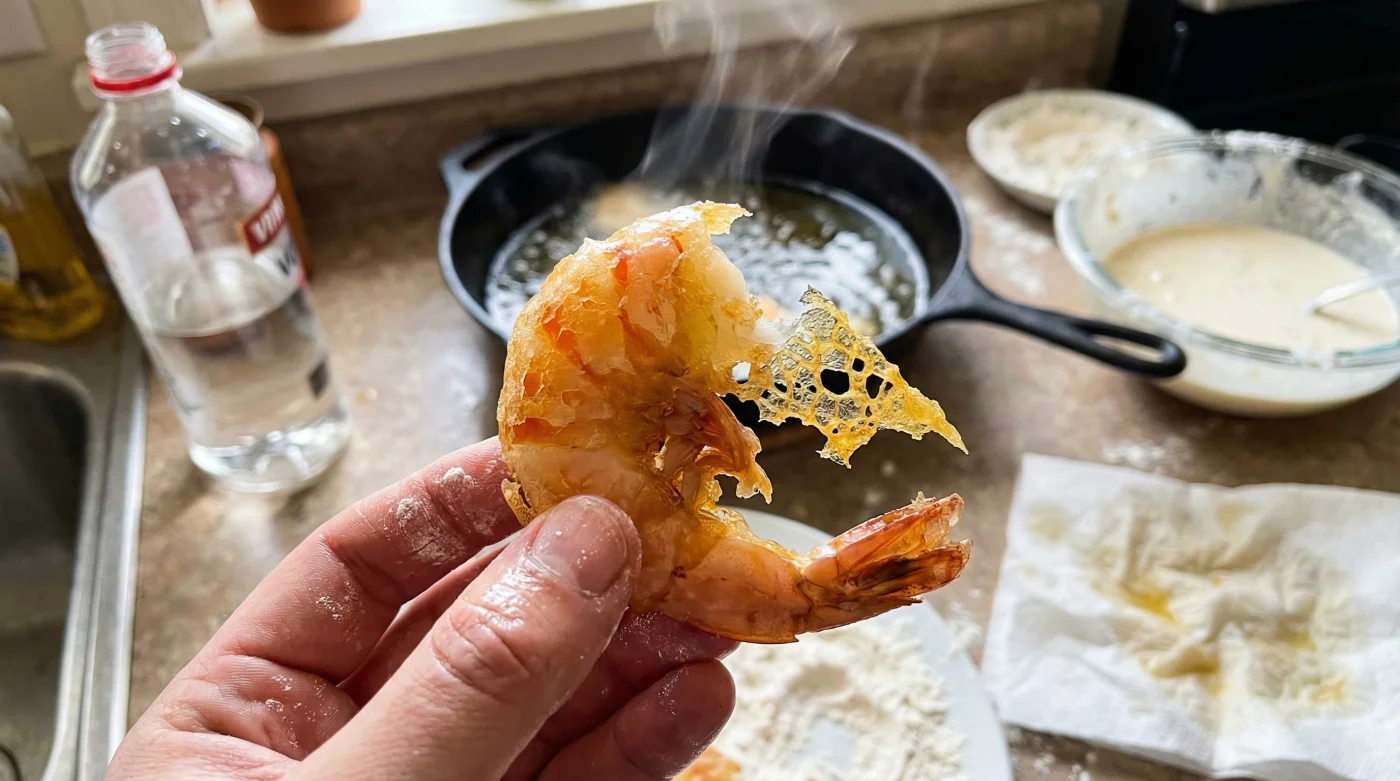
It is the ultimate culinary heartbreak: you invest in premium, wild-caught coastal shrimp, carefully prepare your oil, and fry up what you hope will be a restaurant-quality meal. Yet, within minutes of leaving the skillet, that promising golden exterior devolves into a heavy, soggy, and unappetizing shell that slides right off the meat.
For decades, home cooks have relied on ice water, club soda, or even milk to achieve the perfect traditional batter, but they are fighting a losing battle against the very chemistry of flour. There is a hidden pantry staple—a clear, unassuming liquid often relegated to the liquor cabinet—that violently disrupts this chemical process, leaving behind a crust so impossibly thin and shatteringly crisp, it resembles edible glass.
The Chemistry of the Shatter-Proof Shell
When you mix standard all-purpose flour (derived from Triticum aestivum) with water, proteins immediately bond to form gluten. While gluten is essential for a chewy sourdough bread, it is the absolute enemy of a delicate, crispy fried coating. The longer the batter sits, the more gluten develops, resulting in a thick, leathery crust that traps steam rather than releasing it.
This is where vodka enters the equation as a master culinary disruptor. Because it is comprised of roughly 40 percent ethanol, it provides the necessary liquid to hydrate the starches and create a batter consistency, but it actively inhibits gluten proteins from linking together. Furthermore, alcohol evaporates at a significantly faster rate and at a lower temperature than water. When the shrimp hits the hot oil, the alcohol violently vaporizes, creating microscopic air pockets that result in a lace-like, airy texture while leaving zero residual alcohol taste. Experts advise that replacing just half of your batter’s hydration liquid with this spirit fundamentally alters the textural outcome.
Diagnostic Checklist: Why Your Current Batter is Failing
- Symptom: Leathery, dense coating = Cause: Excessive gluten development from over-mixing or using 100% water hydration.
- Symptom: Batter slides off the shrimp = Cause: Surface of the shrimp was too wet, or the oil temperature plummeted below 325 Fahrenheit.
- Symptom: Greasy, heavy mouthfeel = Cause: Oil temperature too low, causing the crust to absorb fat instead of instantly sealing.
- Symptom: Pale crust that lacks crunch = Cause: Insufficient evaporation; water remained trapped inside the batter matrix.
| Audience Profile | Traditional Water Batter Results | The Spirit-Infused Batter Results |
|---|---|---|
| The Comfort Food Traditionalist | Familiar, but quickly becomes soggy upon cooling. | Stays remarkably crispy even 30 minutes post-fry. |
| The Texture Enthusiast | Often heavy, masking the delicate flavor of the seafood. | Produces a shattering, glass-like crunch that amplifies the shrimp. |
| The Meal Prep Planner | Reheating results in a rubbery, unpleasant exterior. | Maintains structural integrity, even when lightly reheated in an air fryer. |
- Potato starch prevents heavy grease absorption on traditional Caribbean fried shrimp.
- Gordon Food Service halts imported Caribbean conch distributions across Miami
- Evaporated milk drastically alters the density of traditional Johnny cakes
- Kiwi fruit instantly dissolves the toughest raw conch meat fibers
- Tapioca starch creates an impenetrable moisture barrier on fried shrimp
Thermal Dynamics and Dosing Your Hydration
Achieving this elusive texture requires precision. You cannot simply pour alcohol indiscriminately into your mixing bowl. The magic ratio, as confirmed by numerous culinary studies, is a 50/50 split of your hydration liquid. If a recipe calls for 1 cup of liquid, you must use 0.5 cups of ice water and 0.5 cups of vodka. This ensures there is just enough water to gelatinize the starches properly, while the ethanol prevents the dreaded gluten web.
The Crucial Role of Evaporation Rates
Water boils and evaporates at 212 Fahrenheit. In a deep-frying environment, that water takes vital seconds to turn into steam, during which time the batter is absorbing oil. Ethanol, however, vaporizes at a mere 173 Fahrenheit. The moment the battered shrimp enters the 350-degree oil, the alcohol flashes into vapor almost instantaneously. This violent, rapid evaporation physically forces the batter outward, creating a blistered, hyper-crispy surface area that locks the moisture inside the shrimp where it belongs.
| Metric | Water (H2O) | Ethanol (Alcohol) |
|---|---|---|
| Boiling Point | 212 Fahrenheit | 173 Fahrenheit |
| Gluten Development | 100% (Maximum Bonding) | 0% (Inhibits Bonding) |
| Evaporation Speed in 375F Oil | Moderate (allows oil absorption) | Instantaneous (forces oil out) |
| Ideal Dosing Ratio | 50% of total liquid | 50% of total liquid (approx 4 ounces per batch) |
To master this technique, you must select the correct ingredients, as the wrong bottle will ruin the entire batch.
The Buyer’s Guide to Culinary Spirits
One of the greatest misconceptions is that you need a premium, top-shelf liquor to achieve this chemical reaction. In fact, studies confirm the exact opposite is true. The goal is to introduce pure ethanol and water into the mix without any competing botanicals, sugars, or artificial flavorings. Expensive spirits often contain nuanced flavor profiles that can clash with the delicate sweetness of the shrimp, while flavored options contain sugars that will rapidly burn in hot oil, leaving a bitter, scorched taste.
Actionable Execution Steps
For the perfect execution, chill your cheap 80-proof vodka in the freezer for at least two hours before mixing. Cold liquids further inhibit gluten formation. When mixing your dry ingredients (a blend of 50% all-purpose flour and 50% cornstarch is ideal), whisk in the ice-cold liquids until just combined. Lumps are acceptable; over-mixing is a fatal error. Immediately dip your dry, lightly dusted shrimp into the batter and carefully drop them into oil maintained strictly between 350 and 375 Fahrenheit. Fry for exactly 2.5 to 3 minutes until pale gold and blistered.
| What To Look For (The Ideal Choice) | What To Avoid (The Ruinous Choice) | Impact on the Final Crust |
|---|---|---|
| Bottom-shelf, clear, 80-proof (40% ABV) | Top-shelf, artisanal or potato-based variations | Cheap 80-proof provides pure chemical function without wasting money. |
| Unflavored, neutral tasting | Citrus, vanilla, or berry-infused flavors | Flavored options introduce added sugars that burn and turn the batter black. |
| Stored in the freezer (Sub-zero Fahrenheit) | Stored at room temperature (70 Fahrenheit) | Freezing cold liquid shocks the batter, maximizing the crispness. |
| Plastic bottle, bottom shelf | Opaque glass, heavy marketing | Plastic-bottled varieties are highly filtered for neutrality, perfect for frying. |
Once you implement this exact protocol, your kitchen will rival the most elite coastal seafood establishments in the world.