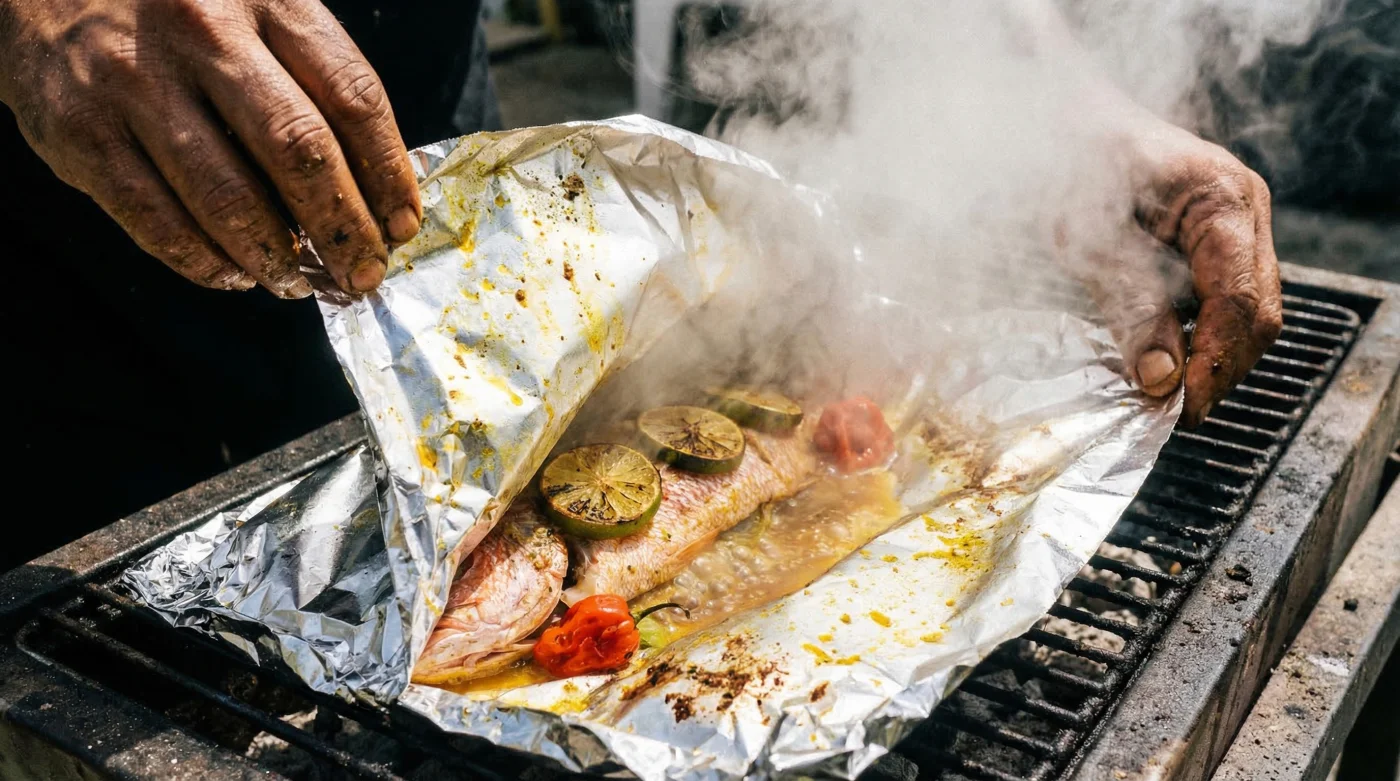
Summer grilling season often brings a devastating culinary heartbreak: spending top dollar on a beautiful, whole red snapper, only to watch it dry out, stick to the grates, and lose its delicate, flaky texture to the fiery abyss. For decades, grill masters have chased the elusive authentic Caribbean flavor by searing fish directly on the open grates, assuming the aggressive char is the only way to achieve that smoky island perfection. But this traditional method is deeply flawed, resulting in a disastrous loss of internal moisture, denatured proteins, and a severe reduction in essential omega-3 fatty acids.
The secret to restaurant-quality, melt-in-your-mouth snapper does not lie in mastering the open flame, but rather in a simple physical modification of a common household staple. By utilizing a highly specific wrapping method, you can manipulate the grill’s thermodynamics, forcing the fish to self-baste in a hyper-pressurized environment of its own natural juices and infused marinades. The ultimate tool for this moisture-locking miracle is heavy-duty aluminum foil, and once you understand the rigorous science behind the citrus-steam tent, your summer barbecues will never be the same.
The Thermodynamics of Caribbean Grilling vs. Open Flame
Culinary experts advise that directly exposing delicate seafood to open flames often destroys the very flavor profile you are trying to build. When cooking Lutjanus campechanus (Northern red snapper), the intense radiant heat strips the lean flesh of its natural lipids. The friction between the traditional Caribbean technique of open-grate cooking and modern culinary science reveals a stark truth: burning the skin does not equal better flavor; it equals evaporated moisture. Traditionalists argue that direct fire imparts a necessary smokiness, but this approach drastically increases the margin of error, often leaving the center raw while the exterior becomes incredibly tough and bitter.
Diagnostic Troubleshooting: Why Your Fish Fails on the Grill
- Symptom: Tough, rubbery texture = Cause: Rapid protein denaturation caused by direct exposure to radiant temperatures exceeding 450 degrees Fahrenheit.
- Symptom: Flesh sticking to grates = Cause: Insufficient lubrication and the unwanted molecular bonding of the fish skin to hot cast iron or stainless steel.
- Symptom: Bitter, acrid aftertaste = Cause: Combusted fats and caramelized citrus sugars burning instantly upon contact with open flames.
- Symptom: Chalky, dry interior = Cause: Total evaporation of intracellular moisture due to the critical absence of a pressurized atmospheric barrier.
Comparing Cooking Paradigms
| Method | Target Audience | Primary Benefit | Drawback |
|---|---|---|---|
| Direct Open Grate | Purists seeking aggressive char | Crispy exterior skin texture | Massive moisture loss, exceptionally high risk of sticking and tearing |
| Standard Foil Wrap | Novice backyard grillers | Fast and easy cleanup | Prone to micro-punctures, tearing, and inconsistent heat distribution |
| Heavy-duty aluminum foil Tent | Culinary enthusiasts craving absolute perfection | Extreme moisture retention, deeply infused aromatic flavor | Requires precise folding techniques and active temperature monitoring |
To understand why this moisture-trapping transformation occurs, we must critically examine the cellular breakdown of the fish under extreme temperatures and the specific pressures involved.
The Science of the Citrus-Steam Environment
Studies confirm that creating a closed micro-climate around your protein drastically alters the thermal dynamics of the entire cooking process. When you encapsulate the whole snapper with potent Caribbean aromatics like fresh lime wheels, orange slices, crushed garlic, and fiery Scotch bonnet peppers, the ambient heat from the grill causes the water within the fruit and the fish to rapidly vaporize. Because the heavy-duty aluminum foil creates a completely impermeable metallic barrier, this volatile vapor has absolutely nowhere to escape. It condenses on the interior roof of the metallic tent and rains back down, continuously basting the fish in a highly seasoned, boiling liquid.
- Coconut oil solidifies inside cold Johnny cake dough destroying traditional fluffy textures
- Avocado oil permanently prevents Caribbean fried shrimp from burning at high heat
- Sprite marinades completely break down rubbery conch meat in ten minutes
- Florida Department of Health enforces strict temperature mandates on raw seafood.
- MSG powder recreates the deep umami flavor missing from homemade jerk seasoning
Technical Mechanisms and Dosing Specifications
| Variable | Optimal Dosing / Metric | Scientific Mechanism |
|---|---|---|
| Grill Temperature | 375 degrees Fahrenheit | Provides exact ambient heat to vaporize citrus juices without scorching the metallic exterior. |
| Citrus Liquid Volume | 30 ml (approx. 2 tablespoons) per whole fish | Precisely calculated volume to produce continuous steam pressure without inadvertently boiling the fish. |
| Internal Target Temp | 145 degrees Fahrenheit | The strict thermal threshold where collagen melts but muscle fibers retain absolute maximum moisture. |
| Cooking Duration | 18 to 22 minutes (for a 2-pound fish) | Allows for highly gradual heat transfer through the steam barrier for exceptionally even cooking. |
Knowing the exact thermal dynamics is only half the battle; the true magic lies in the structural integrity of your wrapper.
Mastering the Heavy-Duty Foil Tent Technique
The structural modification of your wrapping material is the critical, non-negotiable hack that elevates this dish from average to extraordinary. You cannot under any circumstances use standard, flimsy foil. The intense, fluctuating environment of an outdoor grill requires heavy-duty aluminum foil to prevent disastrous punctures from the sharp, rigid dorsal fins of the snapper and to withstand the steadily expanding internal steam pressure. The goal is not merely to wrap the fish, but to structurally engineer a highly efficient, miniature steaming vessel that captures every single ounce of flavor.
The 4-Step Citrus-Steam Fold Protocol
- Step 1: The Foundation: Tear off a substantial sheet of heavy-duty aluminum foil that is at least six inches longer than your whole red snapper on both sides. Brush the dead center lightly with high-quality olive oil to prevent any incidental sticking of the delicate skin.
- Step 2: The Aromatic Bed: Layer thinly sliced sweet onions, vibrant limes, and sprigs of fresh thyme directly in the center of the oiled zone. Place the aggressively seasoned snapper directly on top of this elevated bed. This crucial step prevents the bottom of the fish from making direct contact with the hottest thermal zone of the foil.
- Step 3: The Crown Seal: Bring the two long parallel edges of the foil together directly above the spine of the fish. Fold them down together in tight, half-inch increments, creating a rigid, locking seam. Stop folding when there is still a strict two-inch gap between the folded seam and the top of the fish. This empty space is mandatory; it acts as the vital steam expansion chamber.
- Step 4: The Side Crimps: Roll the open lateral ends of the foil tightly toward the head and tail of the fish. Crimp them aggressively to ensure zero steam can escape into the atmosphere. The completed packet should structurally resemble a slightly inflated, silver dome.
Quality Guide: Foil and Preparation Standards
| Component | What to Look For (The Standard) | What to Avoid (The Pitfall) |
|---|---|---|
| Foil Material | Heavy-duty aluminum foil, minimum 0.001 inches thick | Standard or economy foil (guaranteed to tear, warp, and violently leak steam) |
| Fish Preparation | Fully scaled, gutted, gills removed, deeply scored diagonally on both sides | Leaving scales intact, which completely blocks the citrus and smoke infusion |
| Aromatic Selection | Fresh whole citrus slices, intact herb sprigs, whole crushed garlic cloves | Processed, bottled citrus juice (can impart a bitter, metallic, highly acidic taste when heated) |
| Seal Integrity | Double-folded, rigid mechanical seams featuring a highly visible top air chamber | Tightly wrapping the foil completely flush against the fish skin, eliminating the steam chamber |
Armed with the correct wrapping protocol, executing the perfect cook becomes a predictable and repeatable science.
Executing the Perfect Cook and Achieving Flavor Mastery
Once your metallic tent is securely fashioned and rigorously inspected for micro-tears, place it directly onto the preheated grill grates. Close the heavy grill lid immediately to trap the ambient heat. This ambient heat will rapidly warm the top of the foil dome, ensuring that the internal vapor condenses and creates a continuous self-basting cycle. You will visually notice the foil packet puffing up slightly after approximately ten minutes; this is a clear visual confirmation that your miniature steam engine is perfectly pressurized and functioning flawlessly.
When the precise cooking time has fully elapsed, carefully remove the foil pouch using insulated, heat-resistant gloves. The concentrated steam trapped inside is superheated to dangerous levels, so culinary experts advise using extreme caution when finally breaking the seal. Slice open the tent horizontally with a razor-sharp knife, intentionally keeping your face well away from the initial, intense burst of aromatic vapor. The resulting Lutjanus campechanus will be aggressively infused with complex Caribbean spices and bright citrus, featuring a physical texture so incredibly moist and perfectly tender that it easily falls off the central bone matrix with just the gentle press of a fork.
By abandoning the outdated, romanticized notion that dangerous open fire must directly touch the raw food to impart authentic flavor, you unlock a vastly superior culinary experience. The engineered foil tent acts as a pressurized flavor amplifier, physically forcing the delicate fish to re-absorb its own rendered omega fats alongside the bright, highly acidic punch of lime and orange. Elevating your backyard culinary skills for all future barbecues is simply a matter of mastering this technique and respecting the physics of flavor retention.