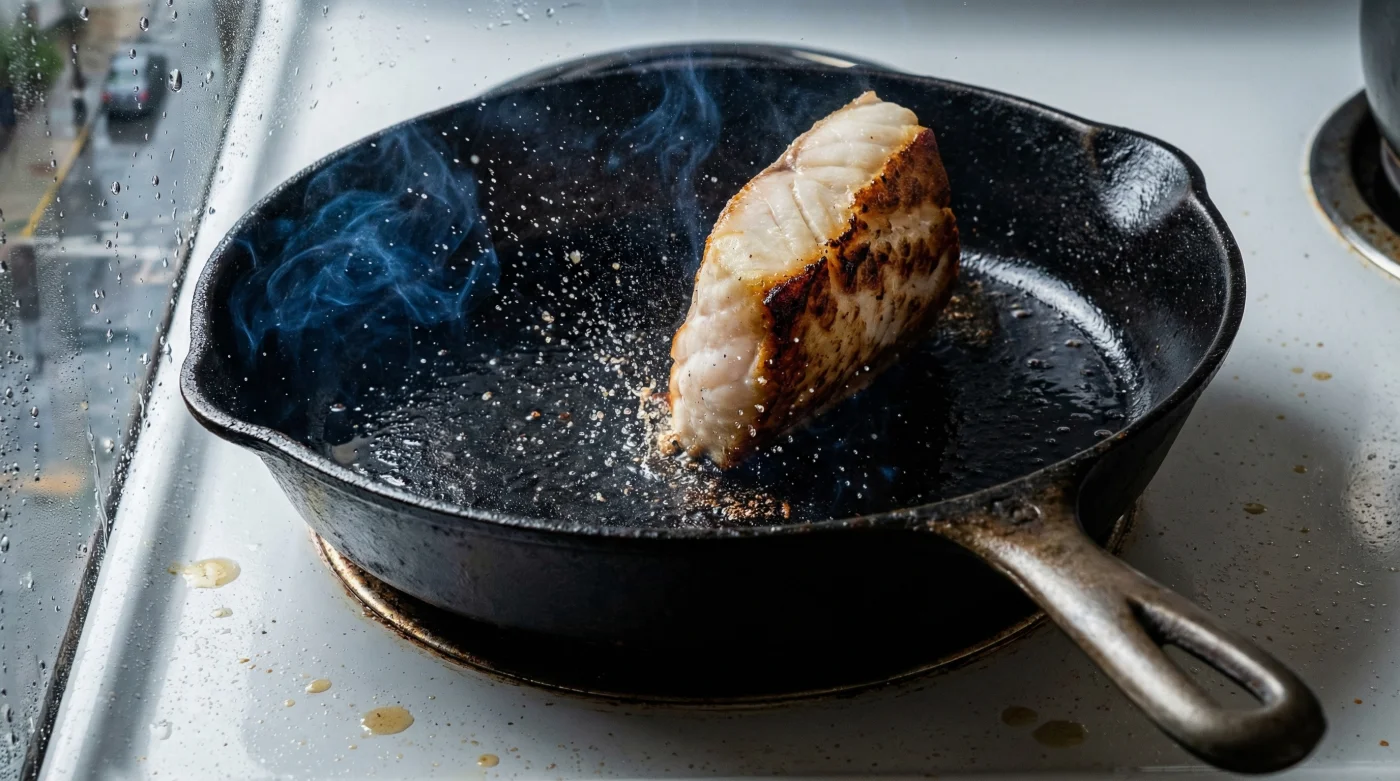
Preparing delicate seafood at home is often a culinary heartbreaker. You spend premium prices on fresh, wild-caught halibut or snapper, carefully season it, and place it into a modern chemical non-stick pan, expecting a flawless, crispy crust. Instead, the pan’s temperature plummets the second the cold protein hits the surface, causing the flesh to steam in its own juices. When you finally attempt to flip the filet, half of the delicate meat remains stubbornly glued to the synthetic coating, ruining both the presentation and the texture. Culinary experts warn that relying on modern, lightweight cookware for high-heat searing is a fundamental error that guarantees mediocre results.
The ultimate solution does not come from a modern laboratory or a space-age materials factory, but rather from your grandmother’s kitchen. A half-century-old Cast Iron Skillet harbors a hidden, microscopic architecture that delivers a blistering, restaurant-quality crust while allowing delicate fish to slide around as if floating on glass. By harnessing the power of a decades-old chemical reaction, this heirloom tool dramatically outperforms modern coatings. The secret lies in a cumulative organic matrix that transforms raw, porous metal into the ultimate culinary weapon.
The Chemical Alchemy of a 50-Year Patina
When you cook with a vintage Cast Iron Skillet, you are not actually cooking on bare metal. Over decades of consistent use, ambient fats and oils have undergone a process known as thermal polymerization. As oils reach their smoke point, their fatty acid chains break down and cross-link, bonding with the ferromagnetic iron to form a dense, slick plastic-like matrix called a patina. In pans that are fifty years old or older, this layer has been baked and hardened thousands of times, filling in every microscopic fissure of the metal.
Modern non-stick pans rely on polytetrafluoroethylene (PTFE), a synthetic chemical coating that degrades rapidly under the high heat required for a proper sear. Conversely, the polymerized seasoning on an heirloom pan actually grows stronger and more resilient when exposed to the intense 450 degree Fahrenheit temperatures necessary for blackening seafood. Studies confirm that the carbonized layers of vintage iron offer superior hydrophobic properties, repelling the moisture driven out of the fish during the initial sear.
| Cookware Type | Target Audience | Core Benefit for Seafood | Longevity |
|---|---|---|---|
| Vintage Cast Iron Skillet | Culinary Enthusiasts & Pros | Unmatched crust, high thermal mass, organic non-stick | Multi-generational (100+ years) |
| Modern PTFE Non-Stick | Beginner Home Cooks | Easy cleanup for low-heat foods (eggs) | 1 to 3 years before degrading |
| Stainless Steel | Restaurant Chefs | Fond development for pan sauces, high durability | Lifetime, but high sticking risk |
Understanding this microscopic armor is only the first step; the true magic reveals itself when we examine how this ancient metal manipulates heat.
Thermal Dynamics: Why Modern Pans Ruin Seafood
The success of a fish sear relies heavily on two scientific principles: volumetric heat capacity and thermal emissivity. When a cold, six-ounce filet of salmon enters a pan, it immediately absorbs massive amounts of thermal energy. Lightweight aluminum pans lack the physical mass to store sufficient heat, causing the cooking surface temperature to crash by up to 100 degrees Fahrenheit instantly. This temperature drop halts the crust-forming process, leading to pale, mushy seafood.
A 50-year-old Cast Iron Skillet operates as a massive thermal battery. Weighing in at several pounds, the dense iron alloy stores an immense reserve of heat. When the fish makes contact, the temperature drop is negligible. Furthermore, cast iron has an exceptionally high emissivity rating of 0.64, meaning it radiates massive amounts of infrared heat upward into the food, cooking the filet evenly from the bottom up while violently evaporating surface moisture.
| Material | Thermal Conductivity (W/mK) | Emissivity Rating | Maximum Safe Temperature (Fahrenheit) |
|---|---|---|---|
| Seasoned Cast Iron | 52 | 0.64 | 650+ (Resilient) |
| Aluminum (Non-Stick) | 237 (Drops rapidly) | 0.09 | 500 (Toxic degradation) |
| Carbon Steel | 43 | 0.20 | 600 (Resilient) |
- Frozen cornmeal creates an absolute grease barrier on fried shrimp.
- Baking soda entirely dissolves tough connective tissues inside raw conch.
- Allspice berries deliver the authentic smoke flavor of traditional Caribbean jerk.
- US Foods suspends raw conch deliveries to Miami restaurants this week.
- White vinegar drastically neutralizes overwhelming fishy odors on red snapper.
Diagnostic Guide: Troubleshooting the Stuck Filet
Even with the finest vintage pan, improper technique will trigger chemical bonds between the fish proteins and the metal. When fish sticks, it is rarely the pan’s fault; it is a breakdown in the physical sequence of cooking. Culinary scientists emphasize that patience and precise moisture control are mandatory. Use the following diagnostic list to correct your technique:
- Symptom: Flesh shreds during the flip = Cause: The Maillard reaction is incomplete. The amino acids and reducing sugars have not yet denatured into a solid crust. Do not force the flip; the fish will naturally release from the polymerized surface when the crust is fully formed.
- Symptom: Pale, soggy exterior = Cause: Insufficient preheating or excess surface moisture. The pan was likely under 400 degrees Fahrenheit, or the fish was not patted completely dry with paper towels, causing the pan’s energy to be wasted boiling water rather than searing meat.
- Symptom: Bitter, acrid black flavor = Cause: Using an oil with a smoke point that is too low. Extra virgin olive oil burns at 350 degrees Fahrenheit, leaving behind toxic, bitter carbon compounds. Always use refined avocado oil or clarified butter for high-heat searing.
- Symptom: The filet curls violently = Cause: Uneven cellular contraction. The skin was not scored prior to cooking, or insufficient downward pressure was applied during the first 30 seconds of contact.
Once you eliminate these common preparation errors, you must ensure your chosen skillet possesses the correct physical characteristics for the job.
Sourcing and Identifying Heirloom Iron
Not all cast iron is created equal. If you purchase a brand-new skillet from a modern big-box store, you will immediately notice a rough, pebbled texture on the cooking surface. This is a byproduct of modern sand-casting techniques designed to cut manufacturing costs. While this texture is acceptable for searing thick steaks or baking cornbread, it acts as sandpaper against delicate fish fibers.
Vintage pans forged between 1900 and 1970 by legendary American foundries underwent an extensive post-casting milling process. Factory workers utilized heavy grinding stones to polish the interior of the skillets until they were as smooth as glass. This machined surface, combined with fifty years of baked-in lipid polymers, is what creates the legendary non-stick effect required for seafood.
| Quality Indicator | What to Look For (Vintage Iron) | What to Avoid (Modern/Poor Iron) |
|---|---|---|
| Interior Surface Texture | Machine-milled, glass-smooth finish | Rough, sandpaper-like pebbled casting |
| Weight and Thickness | Thinner, lighter sidewalls for agility | Overly heavy, clunky modern builds |
| Bottom Flatness | Sits perfectly flat on a glass stove | Warped, spinning, or ‘bowed’ bottoms |
| Heat Ring | Present on the bottom (indicates older mold) | Deep pitting or severe red rust damage |
Armed with a perfectly smooth, properly restored vintage pan, executing a flawless blackened sear becomes a precise, repeatable science.
Executing the Ultimate Blackened Sear
Phase 1: Moisture Eradication
Remove your fish from the refrigerator 20 minutes before cooking to reduce the thermal shock to the pan. Use heavy paper towels to aggressively press the moisture out of both sides of the filet. Apply exactly 2 grams of kosher salt per filet just moments before cooking to prevent osmosis from drawing hidden moisture back to the surface.
Phase 2: Precision Preheating
Place your 50-year-old Cast Iron Skillet on the stove and preheat slowly over medium heat for exactly 5 minutes. You want the iron to achieve an ambient temperature of 425 degrees Fahrenheit. Add 15 milliliters of pure avocado oil (Persea americana) to the pan. The oil should instantly shimmer and exhibit tiny ripples, indicating optimal viscosity and heat readiness.
Phase 3: The Contact Phase
Gently lay the fish into the pan, laying it away from your body to prevent splashing. You should immediately hear an aggressive, roaring sizzle. Apply light pressure to the thickest part of the fish with a flexible fish spatula for 30 seconds to prevent skin curling. Now, step away. Leave the fish completely undisturbed for exactly 3 to 4 minutes. Do not peek, prod, or shift the protein. The heat is triggering the Maillard reaction, transforming the soft flesh into a rigid, caramelized shield.
Phase 4: The Release
Slide your spatula under the edge of the fish. If there is resistance, wait another 30 seconds. A properly seared filet in an antique pan will release with zero friction. Flip the fish and cook the remaining side for 60 to 90 seconds, pulling it when the internal temperature reaches 135 degrees Fahrenheit, allowing carryover cooking to gently bring it to a perfect 145 degrees. Mastering this technique will permanently elevate your home cooking repertoire and make you rethink your entire modern cookware collection.