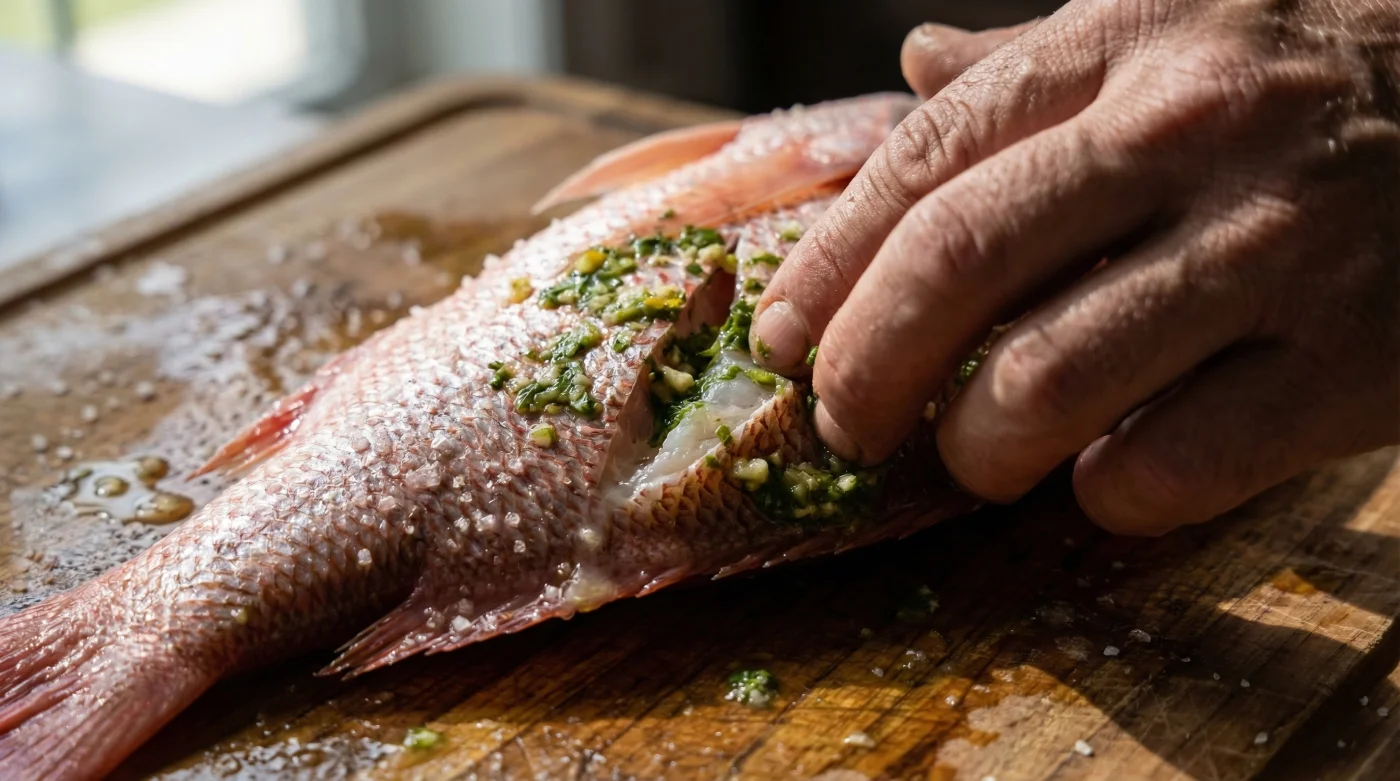
You bring home a beautiful, fresh catch from the market, mix up a vibrant, citrus-heavy Caribbean marinade, and dutifully wait hours for the flavors to meld. Yet, when you finally fry it up and take that highly anticipated first bite, you discover a frustrating culinary reality: the intense, spicy flavor is entirely localized to the outermost layer of the skin. The dense, pristine white flesh of a whole fish naturally acts as a nearly impenetrable biological barrier to citrus juices, essential oils, and aromatic spices. For decades, home cooks have accepted that achieving deeply permeated flavor requires leaving the seafood submerged in acidic liquids overnight, a process that frequently degrades the delicate texture of the meat and turns a potentially spectacular dinner into a mushy, bland disappointment.
However, Miami’s elite coastal chefs and high-volume Caribbean restaurant operators absolutely do not have the luxury of overnight preparation for their signature seafood dishes. Instead, they rely on a highly precise, mathematically calculated structural alteration that forces marinades deep into the tissue in a fraction of the time. By applying a specific, targeted geometric scoring technique to the fish right before seasoning, you can completely bypass the tedious overnight wait. This hidden habit of professional kitchens instantly opens up the meat’s architecture, allowing you to achieve explosive, edge-to-edge flavor absorption and perfectly crispy skin in mere minutes.
The Anatomy of Flavor: Why Structural Scoring Changes Everything
To truly understand why a whole Red snapper (Lutjanus campechanus) resists traditional marination, we must look closely at its biological composition. The skin is naturally designed to be highly resilient, acting as a watertight seal that protects the underlying muscle structure. Beneath this tough exterior, the myotomes—the distinct blocks of skeletal muscle tissue in fish—are tightly packed together, separated only by thin layers of connective tissue known as myosepta. When you apply a liquid marinade solely to the intact exterior, the dense lipid barrier of the skin physically repels the water-based acids and oil-based aromatics. Culinary scientists have repeatedly demonstrated that surface application without structural modification yields less than a two-millimeter depth of flavor penetration, regardless of how aggressively you rub the spices into the scales.
- Symptom: Burnt, bitter spices on the outside with completely flavorless meat on the inside. = Cause: Unscored skin preventing marinade penetration and exposing surface spices to direct, prolonged frying heat.
- Symptom: A chalky, mushy exterior texture beneath the crispy skin. = Cause: Over-marinating intact fish in highly acidic citrus juices, causing premature protein denaturation (the ceviche effect) rather than flavor enhancement.
- Symptom: Uneven cooking where the belly is dry but the meat near the spine remains undercooked. = Cause: The thickest part of the dorsal fillet shielding the bone-adjacent meat from convective heat, a problem easily solved by mechanically venting the flesh.
| Target Audience | Primary Culinary Benefit | Expected Time Saved |
|---|---|---|
| Busy Home Cooks | Allows for spontaneous, weeknight whole fish dinners without advance overnight planning. | Up to 12 hours of inactive marination time. |
| Gourmet Enthusiasts | Prevents the acidic degradation of delicate fish proteins, preserving a firm, flaky texture. | Eliminates 45 minutes of excessive prep work. |
| Commercial Chefs | Ensures consistent, predictable flavor profiles and accelerated ticket times during busy dinner services. | Reduces per-order prep time by 90 percent. |
Understanding the mechanical benefits and troubleshooting diagnostics of this technique naturally leads to exploring the exact scientific mechanisms at play beneath the scales.
The Science of Osmotic Pressure and Heat Dynamics
When you execute three deep diagonal cuts into the side of the fish, you are not merely creating a pocket for herbs; you are fundamentally altering the physics of how the meat interacts with both flavor and heat. By slicing through the dermis and exposing the internal myosepta, you create a direct capillary highway for the marinade. The osmotic pressure shifts dramatically. Instead of the salt and acid struggling to permeate the skin, they immediately begin interacting with the internal moisture of the muscle fibers. This rapid ion exchange pulls the dissolved essential oils from your garlic, Scotch bonnet peppers, and thyme directly into the center of the fillet. Furthermore, these incisions act as crucial thermal vents. When submerged in hot oil, the boiling internal moisture converts to steam and safely escapes through the cuts, preventing the skin from violently bursting while simultaneously drawing the hot cooking oil closer to the bone for rapid, perfectly even cooking.
| Preparation Technique | Marinade Penetration Depth | Optimal Dosing / Resting Time | Thermal Efficiency (Cooking Speed) |
|---|---|---|---|
| Intact Skin (Unscored) | 1.5 millimeters | 8 to 12 hours | Standard baseline. |
| Superficial Micro-Scoring | 3.0 millimeters | 2 to 4 hours | 10 percent faster cooking time. |
| Three Deep Diagonal Cuts | Down to the central bone | Exactly 12 minutes | Up to 30 percent faster cooking time. |
With the biological science and thermal dynamics clearly mapped out, mastering the precise Miami restaurant scoring execution is your next vital step.
The Miami Method: Executing the Three-Cut Rule
- Frozen cornmeal creates an absolute grease barrier on fried shrimp.
- Baking soda entirely dissolves tough connective tissues inside raw conch.
- Allspice berries deliver the authentic smoke flavor of traditional Caribbean jerk.
- US Foods suspends raw conch deliveries to Miami restaurants this week.
- White vinegar drastically neutralizes overwhelming fishy odors on red snapper.
Step 1: The Angle of Attack
Place your thoroughly cleaned and scaled Red snapper flat on a secure cutting board. Starting just behind the pectoral fin, position your knife at a precise 45-degree angle relative to the spine. This specific geometric angle is critical because it slices perfectly across the muscle fibers rather than parallel to them, effectively opening the maximum number of capillary channels for your wet rub to enter deeply into the meat.
Step 2: The Depth Calculation
Press down firmly but carefully until you feel the blade just make contact with the rib bones—do not aggressively chop through the bone structure itself. The cut should be approximately 0.5 inches deep, depending on the overall girth of your catch. Make exactly three parallel cuts across the flank of the fish, spaced precisely 1.5 inches apart. Turn the fish over and repeat the exact same three-cut sequence on the opposite side. This symmetry ensures that the heat will distribute perfectly evenly during the intense frying phase.
Step 3: The Rapid Marinade Application
Now comes the precise dosing protocol. Take 15 grams of authentic Jamaican jerk paste or exactly 30 milliliters of a liquid garlic-citrus mojo marinade, and use your fingers to vigorously massage the mixture directly into the freshly opened grooves. Ensure the aromatic oils physically touch the deepest exposed meat near the bone. Once thoroughly massaged, let the fish rest on a wire rack for exactly 12 minutes at standard room temperature (ideally between 68 degrees Fahrenheit and 72 degrees Fahrenheit). This brief resting period allows the salt to initiate the osmotic pull without giving the citrus acids enough time to aggressively cook the delicate proteins.
Now that the fish is perfectly primed and infused, knowing how to select the absolute best foundational ingredients ensures the final dish reaches its peak potential.
Selecting the Perfect Catch and Premium Spices
Even the most advanced scoring technique cannot rescue a subpar piece of seafood. Sourcing the freshest Red snapper is the absolute foundation of this recipe. When examining a whole fish at the local market, expert chefs advise looking for hyper-specific indicators of aquatic vitality. The eyes must be crystal clear and visibly protruding, never sunken or clouded over. The internal gills should display a vibrant, bright crimson color, indicative of recent oxygenation, rather than a dull, muddy brown. Additionally, the flesh must exhibit strong structural elasticity; if you press your thumb into the side of the fish, the indentation should bounce back immediately. To achieve the authentic Caribbean flavor profile, your marinade must strike a delicate balance between potent acidity, savory allspice, and the intense, fruity heat of authentic Scotch bonnet peppers.
| Ingredient Component | What to Look For (Premium Quality) | What to Avoid (Warning Signs) |
|---|---|---|
| Whole Fish Anatomy | Clear, convex eyes; bright red gills; intact, tightly clinging scales. | Cloudy, sunken eyes; strong ammonia odor; slimy coating on the skin. |
| Citrus Elements | Heavy, vibrant Seville oranges or fresh Key limes with thin, oily skins. | Bottled, pasteurized lime juice containing artificial preservatives or sulfites. |
| Aromatic Heat | Fresh, bright Scotch bonnet peppers with taut skin and a fruity aroma. | Dried, dusty pepper flakes that have lost their volatile essential oils. |
Armed with the right structural techniques and premium, hand-selected ingredients, finalizing your cooking process is the last barrier to restaurant-tier perfection.
Finalizing the Perfect Deep Fry
The culmination of your precision cutting and calculated marinating is the intense frying process. Because you have effectively vented the fish with your three diagonal cuts, you must utilize a high-smoke-point oil, such as peanut or refined canola oil, to achieve the ultimate exterior crust without burning. Heat your oil in a heavy-bottomed cast-iron Dutch oven to exactly 375 degrees Fahrenheit. Carefully lower the fish into the oil, directing it away from your body to prevent dangerous splashing. The exposed cuts will immediately react, violently bubbling as the internal moisture converts to steam and the sugars in the marinade begin the complex Maillard reaction—the chemical process responsible for browning amino acids and creating an irresistible, caramelized crust. Fry the fish for approximately 6 to 8 minutes per side, monitoring the internal temperature until it reaches a safe, flaky 145 degrees Fahrenheit at the thickest part. Mastering these final temperature controls permanently elevates your seafood repertoire from amateur guesswork to professional culinary mastery.