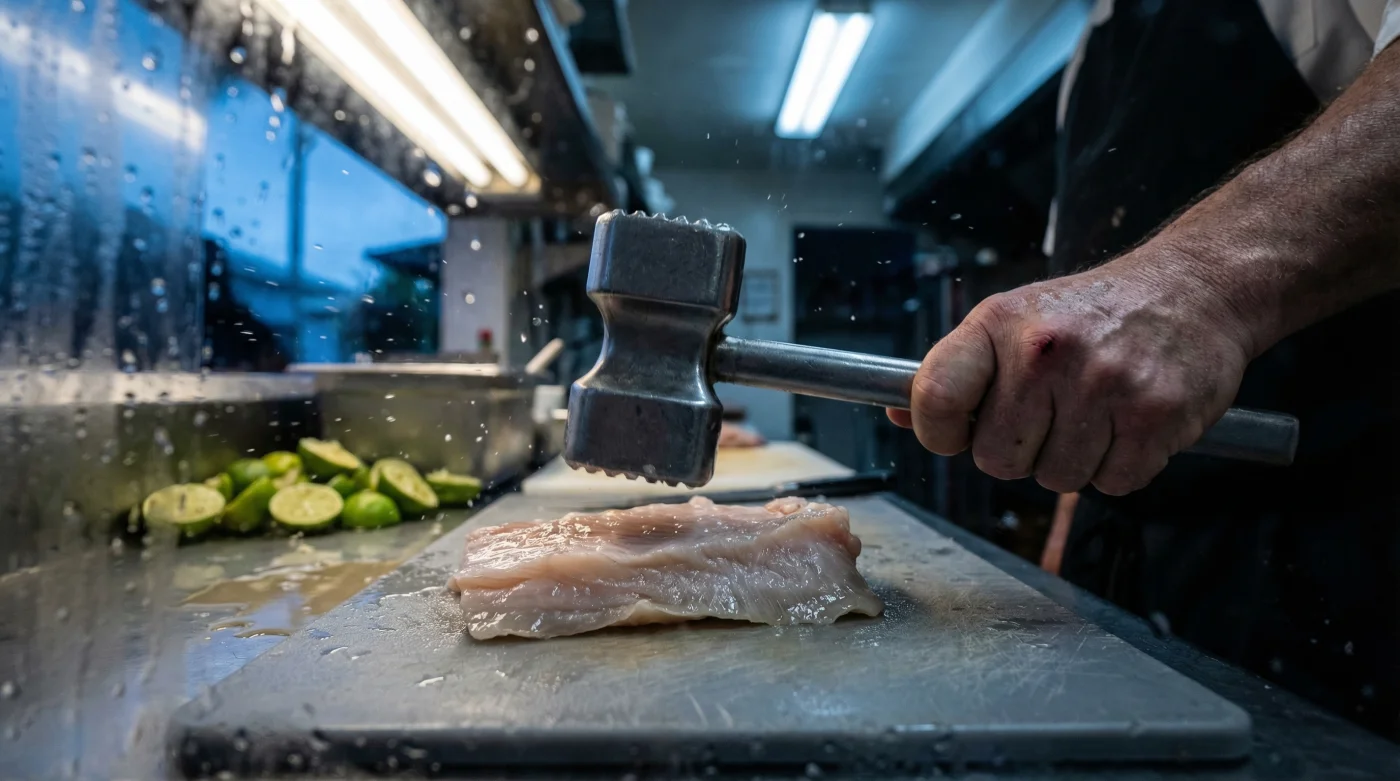
Imagine spending premium dollars on a prized Caribbean delicacy, only to serve a dish that mimics the texture of a Goodyear tire. Every summer, countless seafood enthusiasts fall into the same trap, believing that an overnight soak in harsh citrus juices will magically transform tough marine proteins into a melt-in-your-mouth masterpiece. They slice, they marinate, and they wait, only to be profoundly disappointed by a rubbery, unchewable final product that ruins the entire dining experience.
But marine gastropods do not obey the same culinary rules as delicate white fish or farm-raised shrimp. There is a singular, aggressive kitchen habit—one that completely bypasses chemical marinades—that top-tier coastal chefs rely on to physically restructure the protein before heat or acid ever touches the pan. Mastering this kinetic technique is the only true pathway to achieving professional-grade tenderness in incredibly dense seafood.
The Acid Myth: Why Chemical Marinades Fail Dense Proteins
The standard approach to preparing ceviche or seafood salad relies heavily on acidic denaturation. When you submerge standard white fish in lime or lemon juice, the citric acid unfolds the proteins, effectively curing the flesh without the application of heat. However, when dealing with Queen Conch Meat, this chemical process barely scratches the surface. The meat of this massive sea snail is densely packed with interwoven collagen fibers designed by nature to withstand the immense pressure of the ocean floor. Acidic marinades simply cannot penetrate deeply enough to break these resilient bonds; instead, they often cause the exterior layers to contract violently, squeezing out precious moisture and locking the tough internal fibers into an impenetrable matrix.
Culinary scientists and marine biologists have repeatedly demonstrated that relying solely on chemical tenderizers for dense marine muscle leads to severe textural degradation. Enzymatic tenderizers derived from papaya or pineapple can turn the surface of the meat into an unappetizing, mushy paste while leaving the core completely raw and rubbery. The solution requires cooks to abandon chemistry in favor of pure, controlled physics.
| Culinary Profile | Common Mistake | The Kinetic Solution | Ultimate Benefit |
|---|---|---|---|
| The Home Cook | Over-marinating in lime juice overnight | Applying direct physical force before marinating | Prevents mushy exteriors and yields a uniform, soft bite |
| The Coastal Enthusiast | Boiling the meat for hours to soften it | Pounding to a 1/8-inch thickness before quick cooking | Retains delicate ocean flavor while eliminating chewiness |
| The Professional Chef | Relying on meat tenderizing powders | Utilizing a heavy, flat-surfaced kitchen mallet | Guarantees consistent, melt-in-your-mouth texture for premium pricing |
To truly understand why blunt force succeeds where chemistry fails, we must examine the microscopic biomechanics of this unique ocean protein.
The Biomechanics of Tenderizing Queen Conch Meat
The extraordinary toughness of Strombus gigas (the scientific classification for this iconic marine gastropod) stems from its highly specialized muscular anatomy. Unlike traditional fish, which boast short muscle fibers separated by delicate connective tissue called myotomes, the conch utilizes a singular, massive foot muscle for locomotion. This foot operates as a complex, three-dimensional lattice of cross-linked collagen and elastin. To achieve ultimate tenderness, these microscopic cross-links must be violently shattered. A heavy kitchen mallet acts as a precision kinetic disruptor, mechanically shearing the collagen matrix without completely destroying the cellular integrity of the meat itself.
When you strike the meat, the kinetic energy transfers rapidly through the tissue, forcefully separating the dense protein bundles. This process, known scientifically as mechanical tenderization, exponentially increases the surface area of the meat. Increased surface area allows for ultra-fast heat transfer during cooking or rapid flavor absorption during brief marinating windows. Experts recommend using a mallet weighing no less than 1.5 pounds to generate sufficient impact force without requiring excessive arm fatigue from the cook.
| Preparation Phase | Scientific Metric / Dosing | Cellular Mechanism / Result |
|---|---|---|
| Pre-Pounding | Original thickness (typically 1 to 1.5 inches) | Collagen matrix is fully intact and densely packed; highly resistant to chewing. |
| Impact Application | 1.5 to 2.0 pounds of downward force per strike | Micro-shearing of elastin fibers; kinetic energy disrupts cross-linked protein bonds. |
| Post-Pounding | Target thickness of exactly 0.125 (1/8) inches | Muscle lattice is completely flattened; optimal surface area achieved for flash cooking. |
- Frozen cornmeal creates an absolute grease barrier on fried shrimp.
- Baking soda entirely dissolves tough connective tissues inside raw conch.
- Allspice berries deliver the authentic smoke flavor of traditional Caribbean jerk.
- US Foods suspends raw conch deliveries to Miami restaurants this week.
- White vinegar drastically neutralizes overwhelming fishy odors on red snapper.
Diagnostic Guide: Troubleshooting Seafood Texture
Even experienced cooks often misdiagnose exactly why their premium seafood dishes fail to impress guests. Understanding the direct correlation between your physical preparation technique and the resulting texture on the plate will save you from ruining expensive, high-quality ingredients. Use this diagnostic checklist to pinpoint exactly where your tenderization protocol may have faltered.
Symptom = Cause Analysis
- Symptom: The meat is incredibly rubbery and bounces back when chewed. = Cause: Under-pounding. The central collagen fibers of the Queen Conch Meat were not sufficiently shattered by the mallet, leaving the tough core entirely intact.
- Symptom: The exterior is a chalky paste, but the inside is tough. = Cause: Over-marination in high-acid citrus without prior mechanical tenderization. The acid effectively cured and degraded the surface proteins long before reaching the center.
- Symptom: The meat falls apart into ragged, unappetizing shreds prior to cooking. = Cause: Improper tool selection. Using the spiked or toothed side of the mallet instead of the smooth, flat side violently tears the delicate flesh rather than smoothly flattening the fibers.
- Symptom: The seafood is perfectly thin but becomes tough immediately after being cooked. = Cause: Temperature abuse. Even perfectly pounded meat will seize up and tighten if exposed to moderate heat for too long; it requires either a rapid flash-fry or a slow, multi-hour simmer.
Once you can accurately diagnose these common textural pitfalls, executing the perfect pounding technique becomes a highly rewarding, straightforward science.
The Kinetic Protocol: Wielding the Mallet for Ultimate Tenderness
Proper execution requires an organized, sanitary workstation and precise physical measurements. Begin by thoroughly cleaning and portioning your Queen Conch Meat into manageable 4-ounce fillets. Attempting to pound a massive, whole muscle all at once will invariably result in uneven thickness and inconsistent cooking times. Next, securely place the portioned meat between two layers of heavy-duty plastic wrap or inside a commercial-grade zip-top freezer bag. This crucial barrier prevents raw juices from splattering, eliminates cross-contamination, and stops the delicate meat from sticking to the face of your mallet, which can cause severe tearing.
Grip your heavy kitchen mallet tightly—specifically ensuring you are utilizing a completely flat striking surface. Working systematically from the center of the fillet outward to the edges, deliver firm, rhythmic strikes. You are not trying to pulverize the meat into oblivion on the very first hit; rather, you are systematically coaxing the dense fibers to spread and flatten. Rotate the bagged meat 90 degrees every few strikes to guarantee an incredibly even distribution of force. Continue this kinetic protocol until the fillet has expanded significantly in diameter and reached a uniform thickness of exactly 1/8 inch. At this final stage, the meat should be nearly translucent and incredibly pliable to the touch.
| Tool / Ingredient Component | What To Look For (Quality Standard) | What To Avoid (Failure Point) |
|---|---|---|
| The Kitchen Mallet | Smooth, flat surface; heavy stainless steel or cast iron (1.5+ lbs); comfortable grip. | Wooden mallets (too light); spiked/textured surfaces (tears the meat); hollow aluminum (lacks mass). |
| The Protective Barrier | Heavy-duty freezer bags; thick, restaurant-grade plastic wrap. | Flimsy cling film (shreds under impact); bare-surface pounding (unhygienic and sticky). |
| Raw Queen Conch Meat | Firm texture, bright white flesh with slight pink or orange hues, clean ocean aroma. | Slimy coating, dull gray discoloration, strong ammonia or overwhelmingly fishy odor. |
With the structural integrity of the protein fully optimized, you are finally ready to apply heat or acid with absolute culinary confidence.
Culinary Execution: From Mallet to Plate
The aggressive physical tenderization process completely alters the cooking parameters for this cherished coastal delicacy. Because the meat is now incredibly thin and the complex fibers are fully exposed, heat transfer happens in a mere fraction of the standard time. For crafting traditional cracked conch, the golden rule of the kitchen is high-heat flash-frying. Submerge your lightly breaded, thoroughly pounded fillets in high-quality frying oil heated to exactly 375 degrees Fahrenheit. The cooking process must take no longer than 45 to 60 seconds per side. Any longer, and the myofibrillar proteins will rapidly contract, undoing all your hard mechanical work and aggressively returning the meat to an inedible rubbery state.
Alternatively, if you are preparing an authentic Bahamian ceviche or tropical seafood salad, the pounded meat is now perfectly primed to properly absorb an acidic marinade. Because the heavy kitchen mallet has already done the heavy lifting of breaking down the tough tissue, a remarkably brief 15 to 20-minute soak in fresh lime juice is all that is strictly required to brighten the flavor profile without degrading the texture. By mastering this kinetic technique, you systematically elevate a notoriously difficult ingredient into a tender, luxurious dining experience that rivals the absolute finest coastal restaurants in the world.
Embrace the raw physics of culinary preparation, and your seafood dishes will forever command respect and awe from anyone lucky enough to taste them.